The Coordinates of Kitsch: The Volunteers Charting Every Giant Duck in America
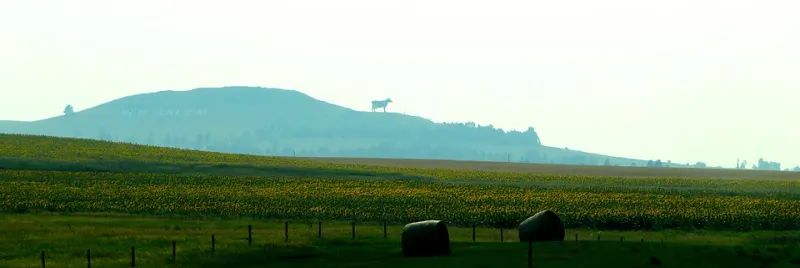
Photo: Ken Lund from Reno, Nevada, USA, CC BY-SA 2.0, via Wikimedia Commons
The first thing you learn talking to people who map roadside attractions is that they do not think of it as a goofy hobby. They think of it as an inventory of things that are quietly disappearing.
'Every one of these has an owner, and every owner is going to die,' one longtime contributor told me, in the tone of a man explaining why he photographs barns. 'The statue goes to scrap or it goes to a scrapyard or the town lets it rot because nobody wants to pay to repaint it. If nobody wrote down where it was, it's just gone.'
A database built by strangers, one detour at a time
The ecosystem is bigger than you'd guess. There are decades-old attraction directories run by obsessives, wikis and waymarking sites where users log coordinates and condition reports, and general-interest travel databases where a giant Paul Bunyan sits in the same taxonomy as a national park. Add the personal layer: Google My Maps files, hand-built KMZ files, and spreadsheet tabs with names like FIBERGLASS and QUESTIONABLE.
The workflow is consistent. Somebody finds a lead — a forum post from 2009, a mention in a county newspaper, a tip from a relative. Somebody else drives out, takes photos from multiple angles, notes the address, checks whether it's visible from a public road, and marks the condition. Then the arguing starts.
Where the fights are
Coordinates are the great recurring dispute. A statue might technically sit in one township but be accessible only via a road in another. Someone's pin lands in a cornfield. Someone else insists the pin should be at the parking lot, not the statue, because that's where you actually go. These are the kind of arguments that sound absurd until you've driven forty minutes down a two-lane highway following a bad pin.
Then there's condition. Is it 'good,' 'weathered,' or 'one arm missing'? Does a repaint count as the same attraction? Muffler men — those hulking, blank-faced fiberglass figures originally built as roadside advertising in the 1960s — get moved, repainted, rebranded, and occasionally decapitated, which means a single entry can have a genuinely complicated biography.
And then there's the biggest fight of all: what counts as a real attraction.
Purists want permanence and craft — hand-built folk art, one-of-a-kind pieces, anything with a story about a guy who welded it himself in 1974. They are unimpressed by a chain restaurant's giant plastic chair, a temporary inflatable that gets packed into a truck, or a 'world's largest' claim that turns out to be the third-largest. Others argue that gatekeeping kills the fun and that a giant duck on a riverbank is a giant duck regardless of its provenance.
Most databases settle on a compromise: keep everything, but rate it. A ranking from 'skip it' to 'worth the detour' is the standard tool. It's the same instinct that drives restaurant reviews, applied to a 25-foot cow.
The vanished list
Here's the part that makes the hobby feel less like kitsch and more like museum work. Serious projects maintain a 'vanished' or 'demolished' category, and it fills up faster than you'd expect. Statues get sold. Mom-and-pop tourist traps close and the land gets developed. Buildings burn. Fiberglass cracks and the town council decides the insurance money is better spent on a new plow.
Volunteers hunt down old postcards to confirm what used to be there, then drive out to see what's standing now. They interview the family that owned it. They photograph whatever remains — a concrete pad, a sign post, a hand-lettered plaque. That's oral history with a camera phone.
Planning a trip around it
If you want to try this yourself, the tactics are simple. Pick a corridor, not a destination. Give yourself a maximum detour of about fifteen minutes per stop. Cluster three or four entries within a county rather than crossing a state for one fiberglass dinosaur. Screenshot your route, because rural cell service is a rumor.
And mind the etiquette that the veteran mapmakers will all mention within the first five minutes: don't climb on sculptures, don't walk past a fence line, don't assume a spot is public just because Google says it's a landmark. Ask the gas station attendant. Buy something.
The best entries, the ones people drive hours for, tend to be on private property where the owner has decided they enjoy visitors. Those places live or die on courtesy.
Why it's worth the spreadsheet
There's an obvious joke here about taking a very silly thing very seriously. But drive a stretch of two-lane highway in Kansas or Pennsylvania or rural Washington, and the argument makes itself. These are the landmarks that small towns could never afford to build and can't afford to lose. A painted fiberglass horse is not Mount Rushmore. It's also the only thing for sixty miles that a stranger might pull over for, buy a soda, and remember.
Somebody ought to write down where it is. Turns out, somebody has.