Peeling Paint, Painted History: The Slow Rescue of America's Brick-Wall Billboards
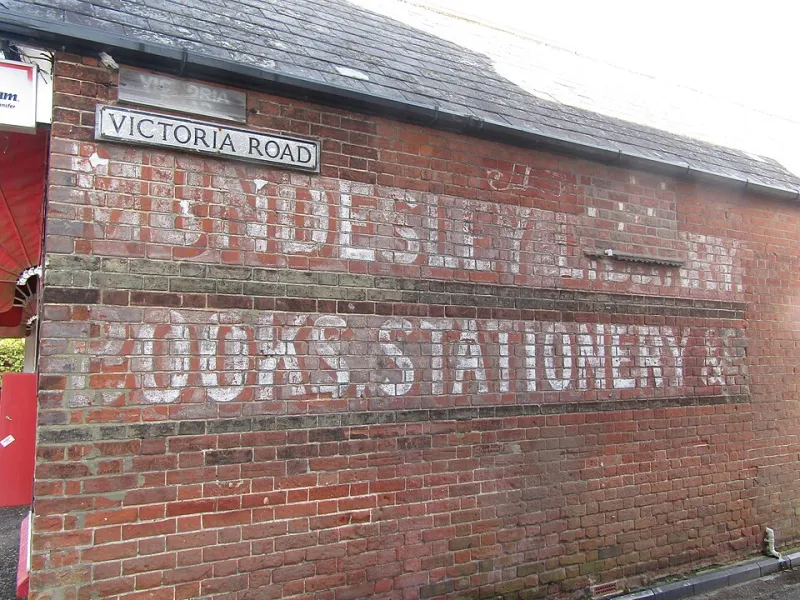
Photo: Kolforn (Kolforn) I'd appreciate if you could mail me ([email protected]) if you want to use this picture out of the Wikimedia project scope. This file is licensed under the Creative Commons Attribution-Share Alike 4.0 International license. Yo
Stand on the right block of almost any American Main Street and look up. Above the awning, past the second-floor windows, there is usually a rectangle of brick that doesn't match the rest — and inside it, in letters a foot tall, a message from a company that no longer exists.
Sometimes it's a soft ghost: the word CHEW barely legible, a cursive Wrigley's Spearmint, a Coca-Cola logo with a five-cent price that hasn't been accurate since the Eisenhower administration. Sometimes it's startlingly crisp, preserved for a century under a shell of later paint that finally gave up.
These are ghost signs, and for most of the last hundred years the standard American response to finding one was a ladder and a bucket of whatever was on sale at the hardware store.
The wall dogs and their one-shot letters
The signs were the work of itinerant sign painters — 'wall dogs,' in the trade — who moved town to town with ladders, brushes, and a kit of dry pigment. To get a design onto a wall three stories up, they pricked the outline of a paper pattern with pinpricks, held it against the brick, and pounced it with a cloth bag of charcoal dust. The dotted outline that appeared was the plan. Everything after that was steady hands and 'one-shot' lettering enamel, mixed on site and thinned with linseed oil.
It was hard, seasonal, unglamorous work paid by the square foot, and it covered enormous amounts of the country. Tobacco companies alone kept crews on the road for decades, trading a fresh coat of paint on a barn in exchange for the right to use the broad side of it. Small businesses bought wall space for a few dollars a year.
Why America spent forty years covering them up
The signs didn't fail all at once. They were outcompeted — by billboards, by neon, by screen-printed vinyl, by aluminum panels bolted to a facade in an afternoon. Then they were zoned out of existence, as cities decided large painted advertising was a nuisance. Then they were simply lived over: a building got re-sided, insulated, tuck-pointed, and painted, and the wall dog's work vanished under three coats of latex.
For a long stretch, nobody thought of the signs as history. They were old advertising, and old advertising was an embarrassment — the visual equivalent of a rotary phone bolted to your house.
That flipped somewhere in the last two decades. Preservation groups started cataloging them. Photographers built archives of fading ads in New York, Cincinnati, Philadelphia, and dozens of smaller towns where a single wall is now the most photographed thing on the block.
What 'saving' one actually involves
Here's where it gets technical, and where well-meaning owners get into trouble. The instinct is to hire a painter and freshen the thing up. Conservators will gently tell you that this is the wrong move for two reasons.
First, the paint. Historic sign paint is mineral-based and vapor-permeable; moisture moves through it and out. A modern acrylic or latex coating locks that moisture inside the brick, and freeze-thaw cycles then pop the face off the masonry in flakes. You can destroy a wall by 'protecting' it.
Second, the evidence. A repainted sign is a re-creation — a pleasing mural about a memory. The original is a document: the original letterforms, the original color shifts, the evidence of how the painter worked and what the wall has been through. Preservationists generally push for stabilization rather than restoration: consolidating flaking pigment, repointing mortar with a lime-based mix that matches the original, gentle cleaning, no sandblasting, no pressure washing.
Costs run from a few thousand dollars to stabilize a small sign to well over twenty thousand for full conservation, lighting, and masonry work. Main Street programs, local preservation grants, and occasionally a crowdfunding campaign pick up the tab. Sometimes it's just one stubborn owner with a soft spot for the building their grandfather bought in 1961.
The new wall dogs
There is a parallel revival worth noting: hand-painted signage itself is back. Sign painters trained in the old craft now letter storefronts and murals across the country, and the same pattern-and-pounce technique shows up in brand work for coffee shops and barbershops. The skill that nearly died out because it was too slow is now valuable precisely because it is slow.
Which makes the ghost signs a strange kind of bridge — a record of the first boom, painted by the spiritual ancestors of the people painting new walls today.
Look up before the scaffolding goes up
If you want to do something useful this week, walk your own downtown and count the ghost signs. Then photograph them, with the address, because the most common way these disappear isn't demolition — it's a routine masonry job, a new coat of primer, and a Tuesday afternoon.
Check whether your state preservation office or local historical society keeps a survey. Add yours if they don't. And if you own a building with one, get a conservator's opinion before you get a painter's estimate. The brick remembers more than we usually give it credit for — but only if we let it.